 FITSTUD.IO
The burning question in the fitness world: Is that post-workout ache, that tell-tale sign of a “good workout,” truly necessary for progress? The simple answer is that the relationship between muscle soreness and gains is complex and often misunderstood.
That familiar tightness and stiffness is formally known as Delayed-Onset Muscle Soreness, or DOMS. Understanding what causes DOMS and what it doesn’t signify is crucial for optimizing your training.
🔬 The Mechanism Behind the Pain: What is DOMS?
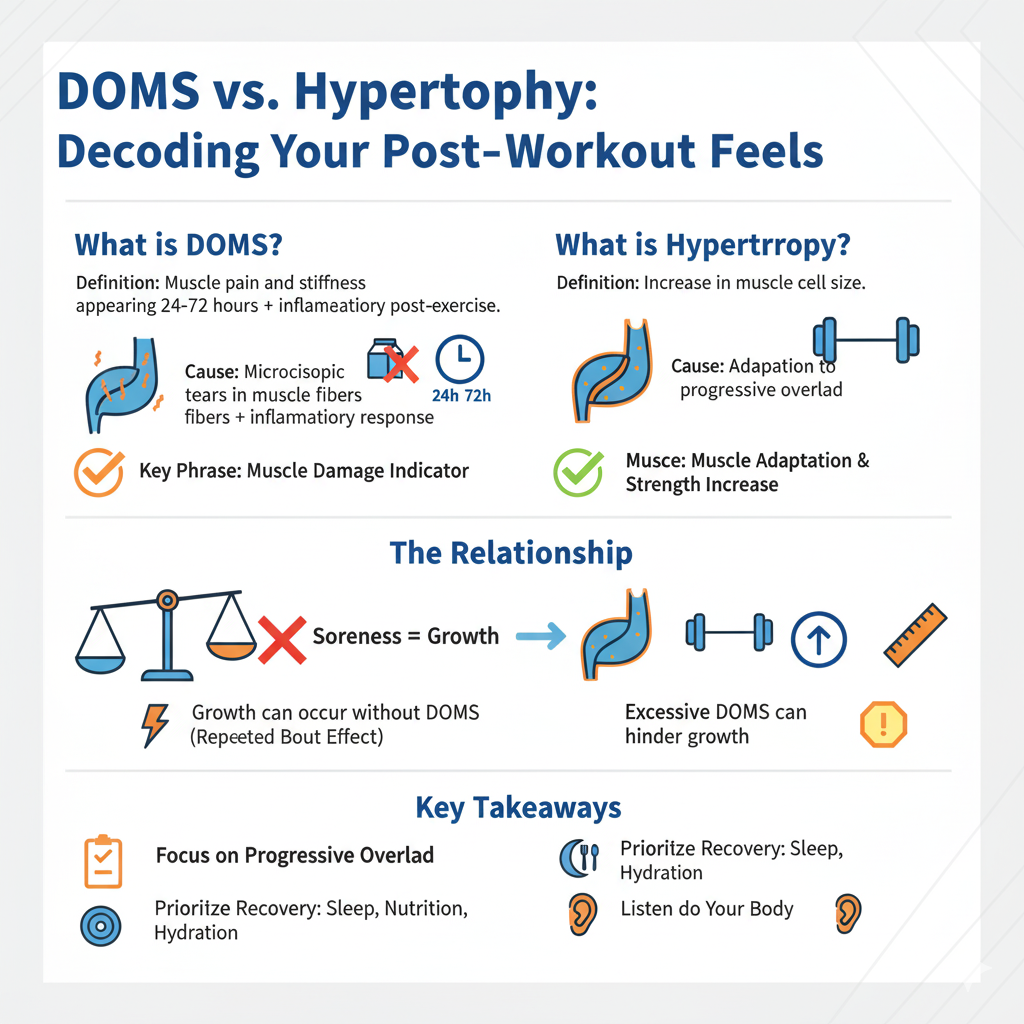
When you engage in resistance training, especially when introducing a new movement or significantly increasing the load, you are causing microscopic damage to the myofibrils (the muscle fibers).
This damage triggers a biological response:
- Inflammation Cascade: The immune system rushes to the site of damage, causing a localized inflammatory response. This response peaks typically between 24 and 72 hours after exercise—hence the delayed onset.
- Chemical Irritation: The breakdown of muscle tissue releases metabolic byproducts (like prostaglandins) that irritate the pain receptors, leading to the sensation of soreness.
It is important to clarify: DOMS is not caused by lactic acid buildup, a common misconception. Lactic acid is cleared from the muscles relatively quickly after exercise.
💪 Soreness vs. Success: The Truth About Hypertrophy
Historically, muscle soreness has been viewed as a prerequisite for muscle growth, or skeletal muscle hypertrophy. This is false.
What Causes Muscle Growth?
Muscle growth is a complex process driven by three primary factors:
- Mechanical Tension: Lifting heavy weights and stretching the muscle under tension (the most important factor).
- Muscle Damage: The microscopic tearing that initiates the repair process.
- Metabolic Stress: The “burn” created by the accumulation of byproducts like lactate and hydrogen ions.
While muscle damage is a component, studies—including work by Dr. Brad Schoenfeld, a leading researcher in hypertrophy—have shown that muscle soreness does not correlate with the degree of muscle growth.
Data Point: During hypertrophy, the muscle fiber incorporates additional myosin and actin filaments (the contractile proteins). Resistance training enhances both the structure and number of these filaments, increasing the muscle’s size and strength. You can achieve this adaptive increase through progressive overload without debilitating soreness.
The key takeaway? Getting stronger, increasing your load, or adding more reps (progressive overload) is the true signal of progress, not how sore you feel the next day.
📉 Why You Get Sore (and Why You Stop)
Soreness is most pronounced in two scenarios:
- The Beginner Effect: When your body is unaccustomed to the stimulus, the damage to the myofibrils is greater.
- Novelty of Movement: Even advanced lifters experience DOMS when they introduce a new exercise pattern or significantly change the exercise tempo (especially the eccentric, or lowering, phase). For example, a veteran squatter switching to an unusually slow, controlled negative on the leg press will likely feel it, as the biomechanics and muscle fiber recruitment are suddenly altered.
The Repeated Bout Effect (RBE)
The reason you stop getting excessively sore is due to a protective adaptation called the Repeated Bout Effect (RBE). After being exposed to a novel exercise, your muscles rapidly adapt. The RBE is a physiological phenomenon where the body becomes resistant to exercise-induced muscle damage, often requiring a significantly greater training stimulus to achieve the same level of soreness.
This is a good thing! It signifies that your body is more resilient and efficient at recovery.
🚨 When Soreness Becomes a Red Flag
While mild DOMS is normal, excessive or specific soreness is a sign that you have over-reached and may be impairing recovery.
| Sign | Meaning | Action |
| Soreness Persists > 72 Hours | Indicates an excessive level of muscle damage or systemic inflammation. | Focus solely on active recovery (light cardio, stretching) and lower volume/intensity next session. |
| Limited Mobility / Struggling with Daily Tasks | Suggests a severe inflammatory response that is affecting your functional movement. | Take a full rest day or use an extremely light recovery session. Prioritize sleep and hydration. |
| Acute, Sharp Pain | Could indicate a muscle strain or minor tear, not just DOMS. | Stop the activity immediately and apply the R.I.C.E. protocol (Rest, Ice, Compression, Elevation). |
| Feeling Weak or Fatigued 2-3 Days Post-Workout | A sign of taxing your Central Nervous System (CNS) too heavily, hindering systemic recovery. | Focus on deloading your next workout to allow the CNS to bounce back. |
Bottom Line: Muscle soreness is an indication of muscle damage, but it is not a reliable measure of muscle growth. If you are consistently hitting new personal records, increasing your lifts, and making physical progress without being perpetually sore, you are succeeding. Prioritize consistency and proper recovery over chasing the burn.

Should You Train When You Don’t Feel Like It? A Coach’s Honest Answer
The Question Every Lifter Eventually Faces Have you ever stood in your gym clothes, staring at the clock, hoping motivation

How Long Does It Really Take to Build a Fitness Habit?
How long does it take to build a fitness habit? Learn the real timeline, common mistakes, and proven strategies to stay consistent long term.